


The Omnilayer Protocol for Sovereign and Institutional Finance
The Mandate
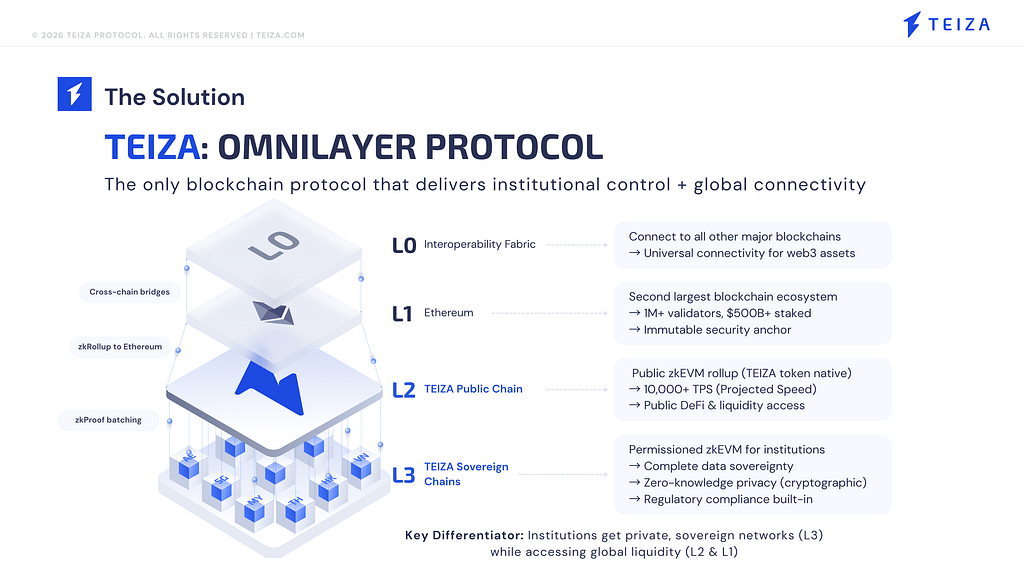
Institutions need digital infrastructure that preserves sovereignty, privacy, monetary policy control, and legal enforceability — while gaining access to global liquidity. Public blockchains compromise on sovereignty and privacy; private chains sacrifice liquidity and interoperability.
TEIZA resolves this through what we call the Institutional DLT Trilemma: delivering (1) Sovereign Control & Privacy, (2) Public Liquidity & Interoperability, and (3) Decentralized Trust & Security — simultaneously, by design rather than compromise.
The Omnilayer Architecture (L0–L3)
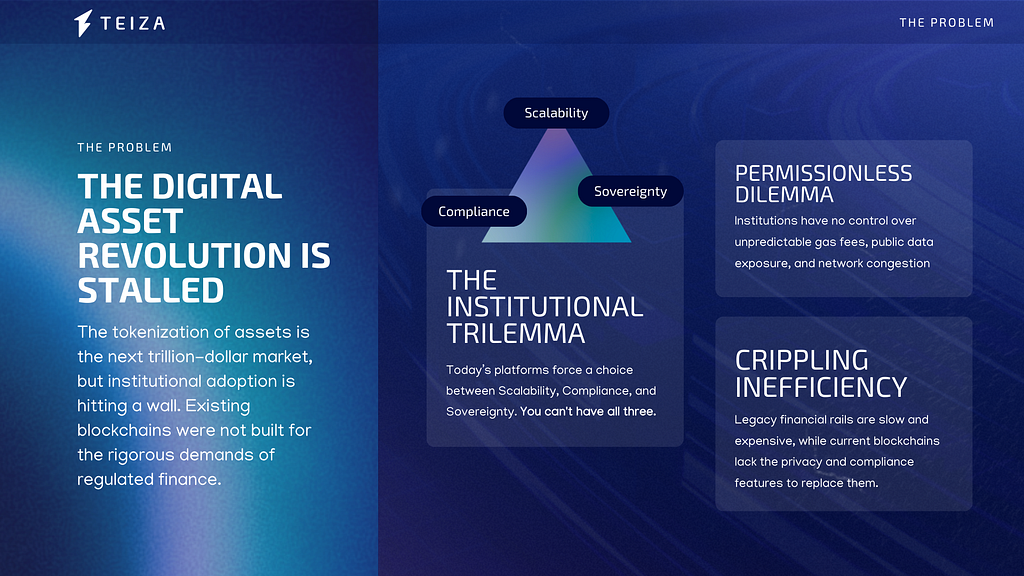
TEIZA separates concerns across four specialised, interoperable layers:
- L3 — Sovereign Networks Jurisdiction-bound, permissioned zkEVM consortium chains with complete data sovereignty. Features include legal wrappers (e.g., CLG), regulator audit nodes, IBFT 2.0 consensus for deterministic finality under 3 seconds, and sovereign policy controls. Institutions maintain full operational control — from validator selection to data residency.
- L2 — TEIZA Public Chain (zkEVM Rollup) A permissionless public blockchain where the TEIZA token is native. Delivers 1,500+ TPS with sub-3-second soft finality, full EVM compatibility, and access to public DeFi liquidity. All state transitions are proven via zero-knowledge proofs and anchored to Ethereum.
- L1 — Ethereum Settlement (Global Trust Anchor) The world’s most decentralised blockchain — 1M+ validators, $500B+ staked — serves as TEIZA’s immutable security anchor. L2 zkRollup proofs are verified on Ethereum mainnet, meaning every TEIZA transaction inherits Ethereum-grade economic finality.
- L0 — Interoperability Fabric CCIP-aligned universal messaging and bridging connecting TEIZA layers to external blockchains (Bitcoin, Solana, BSC) and traditional financial systems (SWIFT, RENTAS) with policy-aware routing.
Core Design Principles
- Sovereignty first. Data residency, selective disclosure via Self-Sovereign Digital Identity (SSDID), and regulator audit nodes ensure institutions never lose control. L3 data stays within national borders — PDPA and GDPR aligned by architecture, not afterthought.
- Liquidity second. L0 and L1 connectivity enables private L3 consortia to access global finance and trade without exposing private state. Institutions get public blockchain liquidity with private blockchain privacy.
- Deterministic trust. zkEVM execution with IBFT 2.0 consensus delivers 1,500+ TPS and sub-3-second deterministic finality — production-proven performance, not speculative projections. Zero-knowledge proofs guarantee validity without revealing data.
- Economic pragmatism. Stablecoin-as-gas on L3 ensures predictable operational costs aligned with institutional budgeting. The TEIZA token secures public layers (L2), with staking, governance, and DeFi utility. Transaction costs are 95%+ lower than legacy systems.
- Adoption readiness. 100% EVM bytecode compatibility means existing Solidity smart contracts deploy unchanged. Familiar tooling (Hardhat, Foundry, Remix) works out of the box. CCIP alignment with emerging institutional interoperability standards.
Why It Matters
- For governments: Built-in data residency and auditability. Regulator nodes provide permissioned oversight without compromising citizen privacy. Court-ready integrity proofs via Ethereum L1 anchoring. Aligned with Malaysia’s National Blockchain Policy.
- For financial institutions: Access public liquidity without exposing proprietary flows or IP. Deterministic settlement eliminates counterparty risk. Confidential transactions via zkEVM — mathematically proven privacy, not trust-based promises. Shariah-compliant by design.
- For enterprises: Predictable fees, enterprise SLAs, and professional deployment support. Supply chain traceability, trade finance, and tokenised assets on sovereign infrastructure with global reach.
- For developers: Familiar EVM toolchain. Deterministic state. High throughput supporting payment systems, markets, and programmable finance. Deploy once on L2, extend to any L3 consortium.
The Bottom Line
TEIZA’s Omnilayer architecture resolves the Institutional DLT Trilemma — not through compromise, but through purpose-built design. Institutions get sovereignty and privacy at L3, global liquidity and Ethereum-grade trust at L1/L2, and universal connectivity at L0.
The $16 trillion tokenisation opportunity has an infrastructure gap. TEIZA closes it.
Official Links
Follow TEIZA on:
X (x.com/teizaprotocol)
LinkedIn (linkedin.com/company/teiza)
Instagram (instagram.com/teizaprotocol) for releases and case studies.
Visit www.teiza.com or connect via email (hello@teiza.com) to explore a sovereign L3 design or interop with your existing rails — TEIZA can blueprint architecture, governance, and economics tailored to your jurisdiction.
